
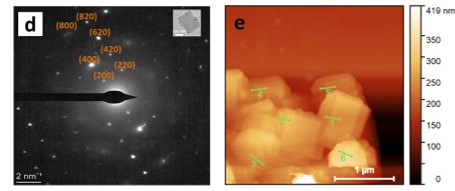
How can optical sensors be made even more sensitive, sustainable, and powerful? This is the question being investigated by the research group led by Professor Christian Klinke at the University of Rostock’s Institute of Physics. In their latest study, the researchers developed novel colloidal, quasi-two-dimensional double-perovskite nanosheets made of Cs₂AgBiBr₆, whose crystal structure is particularly stable and non-toxic. These material properties enable highly sensitive photodetectors and open up new possibilities for future optoelectronic applications.
Photodetectors are indispensable components of modern technologies—from medical imaging and environmental and process sensing to optical communication. The newly developed lead-free double perovskites offer a promising alternative to conventional semiconductor materials and contribute to the development of more powerful and sustainable next-generation photonic devices.
The research was conducted within the Department LL&M at the University of Rostock and exemplifies its interdisciplinary research approach. By combining materials science, physics, and modern nanotechnology, the Department develops innovative methods to understand materials at the atomic and molecular scale and harness them for future technologies—in line with its vision of Atomic & Molecular Scale Sensing.
Publication
Kyesmen, P. I.; Klein, E.; Malani, S. B.; Lesyuk, R.; Klinke, C. Colloidal Quasi-2D Cs₂AgBiBr₆ Double Perovskite Nanosheets: Synthesis and Application as High-Performance Photodetectors.Small2026, 22 (21). https://doi.org/10.1002/smll.202513500