
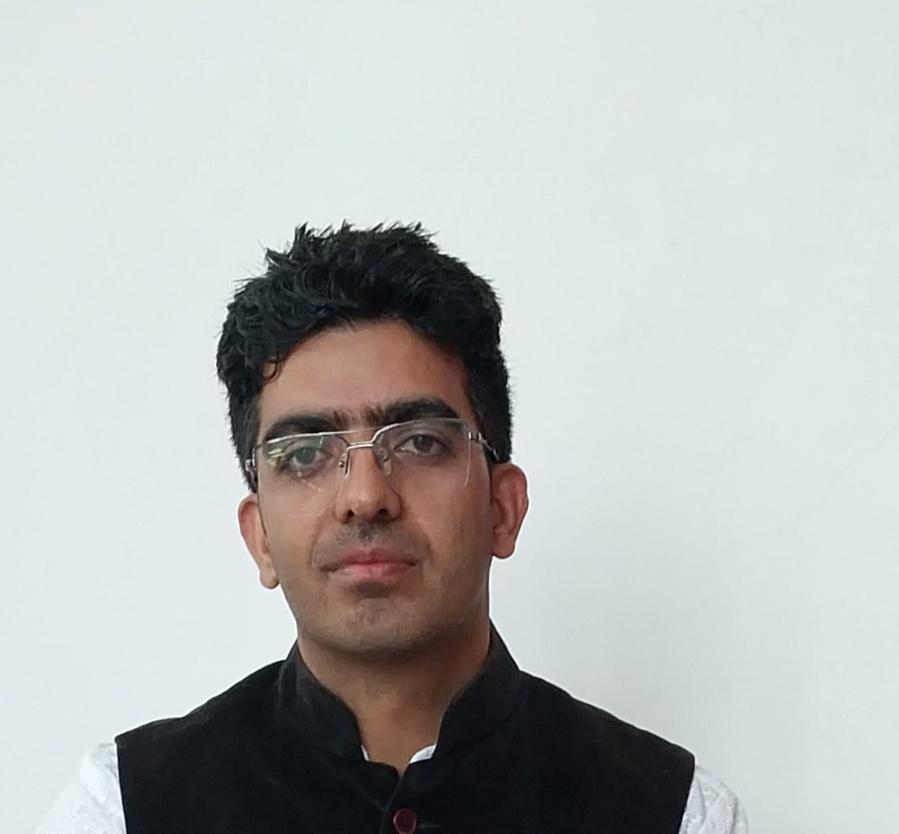
The University of Rostock is pleased to welcome Dr. Waseem Ahmad Wani from University College Dublin (Ireland) as a postdoctoral fellow in the Department of Life, Light & Matter (LL&M) as part of the Mare Balticum Fellowship Program.
During his several-month stay, Dr. Wani will collaborate with Prof. Dr. Hermann Seitz’s research group to investigate novel functional materials for energy-related applications. The focus is on ferroelectric materials for photocatalytic hydrogen production as well as modern nanoscale characterization methods.
The close connection between different disciplines is particularly valuable in this context: The research visit brings together expertise from engineering, materials science, and physics, creating new opportunities for interdisciplinary scientific exchange. In this way, the fellowship makes an important contribution to networking researchers across disciplinary and national boundaries.
In addition to his research, Dr. Wani will also share his expertise in several lectures and workshops with students, doctoral candidates, and researchers at the University of Rostock. The first dates have already been set:
June 30, 2026, 1:00–3:00 pm
Can Atmosphere Control Ferroelectricity? Insights from Hafnia Thin Films
Abstract: Ferroelectric hafnia has transformed the landscape of emerging memory technologies, yet the mechanisms governing its behaviour remain subjects of active debate. Here, we show that the surrounding atmosphere plays a decisive role in determining ferroelectricity in hafnia thin films using piezoresponse force microscopy. Our findings reveal an unexpected interplay between surface chemistry and polarization, offering new insights into the fundamental physics of hafnia and new opportunities for controlling ferroelectric functionality in future electronic and neuromorphic devices.
July 7, 2026, 1:00–3:00 p.m.
Atomic Force Microscopy Beyond Imaging: Characterizing, Mapping, and Engineering the Nanoscale
Abstract: Atomic Force Microscopy (AFM) is far more than an imaging tool. It can map a wide range of physical, chemical, and functional properties at the nanoscale. This talk will introduce the diverse modes of AFM, including topography, mechanical, piezoelectric, electrical, magnetic, and friction measurements, highlighting how a single instrument can provide multidimensional insights into materials and biological systems. Through illustrative examples, we will explore how AFM serves as a versatile platform for researchers across physics, chemistry, biology, and materials science.
A workshop is also in the works. The official invitations will be released shortly and will be available online .