
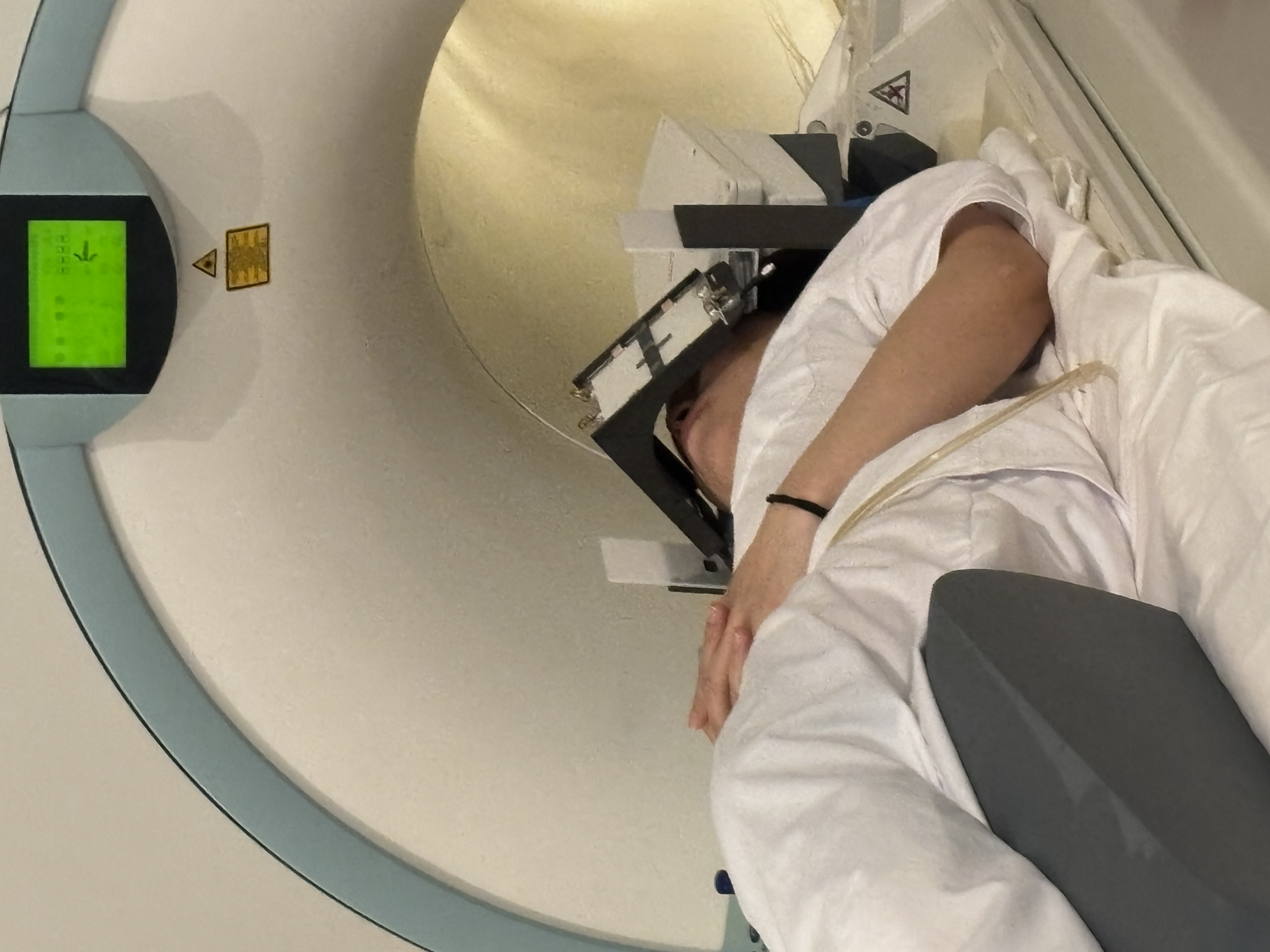
A close and strategically evolved collaboration between Rostock University Medical Center-including the Department of Life, Light & Matter at the University of Rostock-and the Max Delbrück Center in Berlin is yielding tangible results. Together with the team led by Thoralf Niendorf at the Max Delbrück Center, the researchers have developed a novel metamaterial-based MRI antenna that significantly enhances both image quality and efficiency in magnetic resonance imaging. The study was recently published in Advanced Materials.
At the core of this collaboration is the systematic integration of ultra-high-field MRI physics, antenna technology, and clinical imaging. While the Berlin-based team led by Thoralf Niendorf was responsible for the electromagnetic design, simulation, and high-field physical optimization of the metamaterial-integrated RF antenna, the Rostock partners focused on its direct clinical application. The research group led by Oliver Stachs and Ebba Beller integrated the technology into ocular and neuroanatomical 7-tesla imaging and evaluated its performance under real diagnostic conditions, including the visualization of retinal pathologies and occipital brain structures.
“The combination of metamaterial-integrated antenna architecture and 7-tesla MRI enables a level of spatial detail in imaging of the eye and orbit that has not previously been achievable,” explains Ebba Beller, radiologist at Rostock University Medical Center. “What is crucial is not only the improvement in physical performance, but also the immediate translatability into clinical applications.”
By integrating metamaterials into the RF antenna, radiofrequency fields can be selectively focused and amplified. The result is a markedly improved signal quality from deep-lying or anatomically complex regions, accompanied by shorter acquisition times and without the need to modify existing MRI infrastructure.
This long-standing collaboration between Berlin and Rostock-shaped by reciprocal research visits-serves as a prime example of how applied fundamental physics and translational medicine can work hand in hand to transfer technically demanding innovations directly into clinically viable imaging technologies. Looking ahead, the approach holds promise far beyond ophthalmology, with potential applications ranging from cardiovascular imaging to MRI-guided therapeutic procedures.
Literature:
Saha N, Nurzed B, Berangi M, Kuehne A, Waiczies H, Ceja IFT, Hu X, Gladytz T, Krenz L, Huebler D, Endemann B, Brockmann C, Beller E, Stachs O, Niendorf (2026) “Metamaterial Antennas Enhance MRI of the Eye and Occipital Brain” Advanced Materials. DOI:10.1002/adma.202517760
The project was funded by the German Research Foundation (DFG) as part of a joint collaborative research initiative between the Max Delbrück Center and Rostock University Medical Center.
Contact:
Prof. Thoralf Niendorf
Group Leader
Experimental Ultrahigh Field Magnetic Resonance
Max Delbrück Center
thoralf.niendorf@mdc-berlin.de
Prof. Oliver Stachs
Group Leader
Experimental Ophthalmology
Rostock University Medical Center / Department Life, Light & Matter
oliver.stachs@uni-rostock.de