



A research team led by Dr. Fagui He and Prof. Dr. Christian Klinke at the University of Rostock, within the Department Life, Light & Matter, has achieved a significant advance in materials science.
The researchers developed a scalable and cost-efficient method for producing ultraflat bismuth nanocrystals with exceptional stability and high crystalline quality.
The study, published in the journal Small, demonstrates for the first time that the electronic properties of individual two-dimensional nanostructures can be directly mapped experimentally.
This is made possible by a precisely controlled colloidal synthesis that allows the lateral size of the nanosheets to be tuned in a targeted manner. Larger crystals, in particular, exhibit high resistance
to oxidation and long-term stability under ambient conditions.
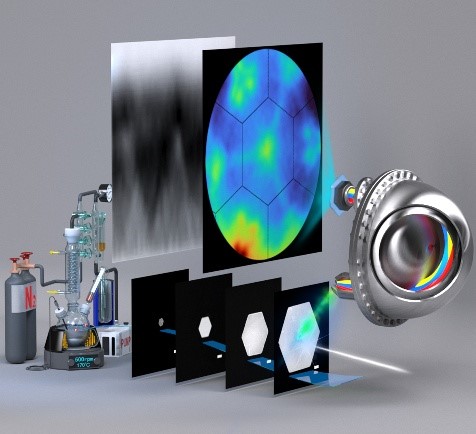
A key result of the work is the successful investigation of individual nanocrystals using high-resolution m-ARPES measurements at the ELETTRA synchrotron in Trieste. The experimentally determined electronic band structure shows excellent agreement with theoretical calculations, confirming the high quality of the material. These findings highlight the potential of solution-based synthesis methods as a scalable platform for the development of future quantum, spintronic, and energy technologies.
Publication:
Fagui He, Yan Yan Grisan Qiu, Simone Mearini, Vitaliy Feyer, Kevin Oldenburg, Rostyslav Lesyuk,
Christian Klinke: Tunable Colloidal Synthesis Enabling m-ARPES on Individual Two-dimensional
Bismuth Nanocrystals, Small (2026) e12032, doi.org/10.1002/smll.202512032
Contact:
Prof. Dr. Christian Klinke
Institute of Physics, University of Rostock
christian.klinke@uni-rostock.de